Hans Albers (1891- 1960)
 The
"Splendid Chap from the Coast" (Albers was born in Hamburg and identified
with the northern coastal region of Germany) was without rival in his role
as the rugged blond ideal of manhood. He led a victorious series of adventurous
tales in which he played the hard-fighting and woman-loving hero, and became
an endearing attraction to the German public. Many of his fans fantasized
their own unfulfilled dreams through his films. Albers’ enormous popularity
guaranteed him virtual immunity from persecution after Hitler seized power
in Germany, despite his sometimes hasty declarations against Nazi Party
inviolability. Albers began his film career in 1911 as a supporting actor
playing the roles of crooks, confidence men, pimps and lovers. In 1930
he achieved stardom at the side of Marlene Dietrich in "The Blue Angel"
(also known in the US as “Mazeppa, the Strong Man”), and was only cast
in leading roles thereafter. Albers remained a movie favorite even after
the defeat of Nazi Germany, and his postwar success gained him renewed
international acceptance. He played himself in the 1958 movie, “It Only
Happened Once”. The
"Splendid Chap from the Coast" (Albers was born in Hamburg and identified
with the northern coastal region of Germany) was without rival in his role
as the rugged blond ideal of manhood. He led a victorious series of adventurous
tales in which he played the hard-fighting and woman-loving hero, and became
an endearing attraction to the German public. Many of his fans fantasized
their own unfulfilled dreams through his films. Albers’ enormous popularity
guaranteed him virtual immunity from persecution after Hitler seized power
in Germany, despite his sometimes hasty declarations against Nazi Party
inviolability. Albers began his film career in 1911 as a supporting actor
playing the roles of crooks, confidence men, pimps and lovers. In 1930
he achieved stardom at the side of Marlene Dietrich in "The Blue Angel"
(also known in the US as “Mazeppa, the Strong Man”), and was only cast
in leading roles thereafter. Albers remained a movie favorite even after
the defeat of Nazi Germany, and his postwar success gained him renewed
international acceptance. He played himself in the 1958 movie, “It Only
Happened Once”. |
Listen to:

Erfolgssong
|
Listen to:
Flieger, grüß'
mir die Sonne
|
Listen to:
Jawoll, meine Herr'n
|
Willy Fritsch (1901-1973)
 |
Willy Fritsch, born Wilhelm Anton Frohs in
Silesia, made his movie debut in 1923 with “His Mysterious Adventure”,
and remained popular as a juvenile lover in silent pictures. However, his
real success came after being paired with Lilian Harvey in 1928, and they
appeared regularly together in movies released every year thereafter until
1937. Fritsch became famous as the carefree and optimistic hero of everyday
life in his musical comedies and light operettas. The Nazi takeover of
Germany did not interrupt his career, and in fact some of his wartime movies
-- such as the 1942 production of “Vienna Blood” -- were re-released in
the United States after the war (“Vienna Blood”, 1951). This certainly
proved his enduring international appeal. Following the defeat of the Reich,
Fritsch remained in German movies and his 1946 “The Bat” was released in
America two years later. He kept acting until 1964, when “I Learned It
From Father” became the last of his hundred-plus films. |
Listen to:
Ich laß mir meinen Körper schwarz
bepinseln
|
Johannes Heesters (born
1903)
 |
Heesters was born in Amersfoort, Netherlands,
and entered movies in the 1924 production of “The Holland Circus”. He became
a successful tenor during the 1930s at the Viennese Folk-Opera, and entered
Austrian films with the 1935 production of “The Four Miller Girls”. Despite
his native Dutch background, the Nazi government approved this UFA discovery
for German movies, where he became known as Jopies. Heesters also enjoyed
acclaim in America after “When Women Keep Silent” was released in the United
States during 1937. The graceful charm of his movements and nasal tone
became Jopies’ trademarks. Heesters remained a star of German wartime movies,
which were typified by operetta films and musical comedies such as the
1943 “Carnival of Love”. Following the defeat of Nazi Germany, Heesters
returned to Austria and his 1947 “Viennese Melodies” soon enjoyed added
success in Britain. Many of his postwar movies, such as the 1955 “Star
From Rio”, were released in the United States. Today Heesters continues
to enjoy world renown as one of its oldest actors. |
Listen to:
Man müßte Klavier spielen können
|
Listen to:
Mein Herz müßte ein
Rundfunksender sein
|
Emil Jannings (1884-1950)
 Jannings,
the first German male cinema star to achieve world-class standing, was
undoubtedly one of the most important actors of his time. He was born as
Theodor Janenz in Switzerland and started acting in 1914, achieving breakthrough
status with his brilliant portrayal of King Ludwig XV in Ernst Lubitsch’s
1919 production of "Madame DuBarry". Jannings increased his fame with acclaimed
roles as a hotel porter degraded to toilet attendant in “The Last Man aka
The Last Laugh” (1924), Mephisto in “Faust” (1926) and Mr. Tartueff in
“Herr Tartueff” (1926). Recognizing his superb European talent, Hollywood
brought Jannings to America where he won the first coveted Oscar award
for his performance as Grand Duke Sergius Alexander in the 1928 film “The
Last Command”. Unfortunately, the move’s subsequent release as a sound
version revealed his insufficient command of English, and forced his return
to Germany There, in 1930, he starred as Professor Immanuel Rath in the
first German sound film, “The Blue Angel”. When Hitler took over Germany,
Jannings was quickly adopted by the Nazi regime and was hailed as the National
Socialist ideal of a native actor with intuitive Germanic blood (although
he was actually of Swiss descent). Of course, the Nazis were only too happy
to secure the loyalty of his immense cult following, and elevated Jannings
to official National Actor for the State of Germany. The numerous propaganda
films that followed were typified by his portrayal of a steadfast Bismarck
in “The Dismissal” (1942). As a testament to Jannings’ true global status,
he continued to work after the war despite his previously cozy relationship
to Hitler’s regime. For example, he starred in “Wonderful Times”, produced
in Germany in 1950 and released in the United States the next year. Jannings,
the first German male cinema star to achieve world-class standing, was
undoubtedly one of the most important actors of his time. He was born as
Theodor Janenz in Switzerland and started acting in 1914, achieving breakthrough
status with his brilliant portrayal of King Ludwig XV in Ernst Lubitsch’s
1919 production of "Madame DuBarry". Jannings increased his fame with acclaimed
roles as a hotel porter degraded to toilet attendant in “The Last Man aka
The Last Laugh” (1924), Mephisto in “Faust” (1926) and Mr. Tartueff in
“Herr Tartueff” (1926). Recognizing his superb European talent, Hollywood
brought Jannings to America where he won the first coveted Oscar award
for his performance as Grand Duke Sergius Alexander in the 1928 film “The
Last Command”. Unfortunately, the move’s subsequent release as a sound
version revealed his insufficient command of English, and forced his return
to Germany There, in 1930, he starred as Professor Immanuel Rath in the
first German sound film, “The Blue Angel”. When Hitler took over Germany,
Jannings was quickly adopted by the Nazi regime and was hailed as the National
Socialist ideal of a native actor with intuitive Germanic blood (although
he was actually of Swiss descent). Of course, the Nazis were only too happy
to secure the loyalty of his immense cult following, and elevated Jannings
to official National Actor for the State of Germany. The numerous propaganda
films that followed were typified by his portrayal of a steadfast Bismarck
in “The Dismissal” (1942). As a testament to Jannings’ true global status,
he continued to work after the war despite his previously cozy relationship
to Hitler’s regime. For example, he starred in “Wonderful Times”, produced
in Germany in 1950 and released in the United States the next year. |
Heinz Rühmann (1902-1994)
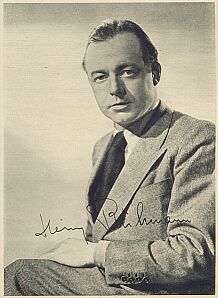 The
shy and playfully mischievous Ruehmann was the public’s favorite actor
of the Third Reich. He embodied the likeable eccentricity of an ordinary
person, and he was usually cast as a pedantic and shy -- even cowardly
-- person who normally did not attract women. However, luck and diligence
always enabled him to win the girl by the end of the film. Ruehmann began
his film career in 1926 and achieved stardom in the 1930 film, “Three From
the Gas Station”. Many of his prewar movies were also released for American
consumption. Ruehmann enjoyed continued success in Nazi films, but one
strange irony involved a Jewish girl who adored his movies -- Anne Frank.
This girl, who authored “Diary of a Young Girl”, always kept his picture
above her bed in Amsterdam until she was discovered and sent to her death
at a concentration camp. Ruehmann’s postwar career was also successful
and included such US films as “The Captain from Kopernick” (1956) and “It
Happened in Broad Daylight” (1958), although he shifted to television acting
after 1968. One of his German wartime movies, “The Fire-Tongue Bowl” (1943)
still enjoys a cult following among German students. The
shy and playfully mischievous Ruehmann was the public’s favorite actor
of the Third Reich. He embodied the likeable eccentricity of an ordinary
person, and he was usually cast as a pedantic and shy -- even cowardly
-- person who normally did not attract women. However, luck and diligence
always enabled him to win the girl by the end of the film. Ruehmann began
his film career in 1926 and achieved stardom in the 1930 film, “Three From
the Gas Station”. Many of his prewar movies were also released for American
consumption. Ruehmann enjoyed continued success in Nazi films, but one
strange irony involved a Jewish girl who adored his movies -- Anne Frank.
This girl, who authored “Diary of a Young Girl”, always kept his picture
above her bed in Amsterdam until she was discovered and sent to her death
at a concentration camp. Ruehmann’s postwar career was also successful
and included such US films as “The Captain from Kopernick” (1956) and “It
Happened in Broad Daylight” (1958), although he shifted to television acting
after 1968. One of his German wartime movies, “The Fire-Tongue Bowl” (1943)
still enjoys a cult following among German students. |
Listen to:
Ich brech' die Herzen
der stolzesten Frauen
|
Listen to:
Jawoll, meine Herrn
|
Listen to:
Das kann doch
einen Seemann
nicht erschüttern
|
Marlene Dietrich (1901-1992)
 Marlene
combined a charmingly beautiful figure with lusty eyes and voice to dominate
the German film industry before refusing Nazi overtures to forego Hollywood
and stay a star in Hitler’s Germany. She was initially a cabaret singer
in 1920’s Berlin and landed minor film roles before achieving stardom with
her brilliant performance of a cabaret singer in the 1930 film, “The Blue
Angel”. She was immediately endorsed by Hollywood and realized international
success that same year in the US-produced “Morocco”. Her American triumph
enabled her to become the most highly paid actress of her time, and later
to refuse Hitler’s overtures. Marlene became a United States citizen and
during World War II she campaigned tirelessly for the Allied cause and
frequently toured American service camps as part of her entertainment circuit.
She never returned to Germany and spend the last thirteen years of her
life in Paris. Marlene
combined a charmingly beautiful figure with lusty eyes and voice to dominate
the German film industry before refusing Nazi overtures to forego Hollywood
and stay a star in Hitler’s Germany. She was initially a cabaret singer
in 1920’s Berlin and landed minor film roles before achieving stardom with
her brilliant performance of a cabaret singer in the 1930 film, “The Blue
Angel”. She was immediately endorsed by Hollywood and realized international
success that same year in the US-produced “Morocco”. Her American triumph
enabled her to become the most highly paid actress of her time, and later
to refuse Hitler’s overtures. Marlene became a United States citizen and
during World War II she campaigned tirelessly for the Allied cause and
frequently toured American service camps as part of her entertainment circuit.
She never returned to Germany and spend the last thirteen years of her
life in Paris. |
Listen to:
Naughty Lola
|
Lilian Harvey (1906-1968)
 Lilian
Harvey was born on 19 January 1906 in England as Lilian Helen Muriel Pape
of an English mother and German father. She spent the first part of her
childhood in England and later moved to Germany, being formally trained
as a ballet dancer. She began her movie career in 1925 and soon starred
together with Willy Fritsch. They became the most popular starring pair
of German movies produced in the 1930s. Lilian coupled her gorgeous sensuality
with a sporty and graceful flair for beautifully acrobatic movement. However,
her attempts to break into Hollywood movies failed (“Seven Slaps” released
in the US during 1937). Her professional career in Nazi Germany was terminated
in 1939 when earlier attempts to aid the escape of a Jewish colleague were
brought to the attention of the authorities. She was forced to emigrate,
and reestablished herself to a limited degree in France after the war. Lilian
Harvey was born on 19 January 1906 in England as Lilian Helen Muriel Pape
of an English mother and German father. She spent the first part of her
childhood in England and later moved to Germany, being formally trained
as a ballet dancer. She began her movie career in 1925 and soon starred
together with Willy Fritsch. They became the most popular starring pair
of German movies produced in the 1930s. Lilian coupled her gorgeous sensuality
with a sporty and graceful flair for beautifully acrobatic movement. However,
her attempts to break into Hollywood movies failed (“Seven Slaps” released
in the US during 1937). Her professional career in Nazi Germany was terminated
in 1939 when earlier attempts to aid the escape of a Jewish colleague were
brought to the attention of the authorities. She was forced to emigrate,
and reestablished herself to a limited degree in France after the war. |
Listen to:
Das gibt's nur einmal
|
Zarah Leander (1907-1981)
 Zarah
Leander was a Swedish actress (born Zarah Hedbeg in Karlstad, Sweden, on
15 March 1907) who became the leading lady of German film under Nazi tutelage.
She was brought to screen prominence as a replacement for Marlene Dietrich,
and her 1937 appearance as Gloria Vane in “Life Begins Anew” quickly established
her as an audience favorite. Zarah combined the alluring sophistication
of her film talent with a rich, deep singing voice that fascinated the
German public. Her roles typically involved playing the woman who learns
self-denial, reflecting perfectly the National Socialist feminine role
model. However, in 1942 she quit UFA over clumsy Nazi attempts to have
her renounce her native citizenship and stormed back to Sweden. She reentered
the postwar theater and film/television market, although she gained more
fame as a singer on public concert tours. Zarah
Leander was a Swedish actress (born Zarah Hedbeg in Karlstad, Sweden, on
15 March 1907) who became the leading lady of German film under Nazi tutelage.
She was brought to screen prominence as a replacement for Marlene Dietrich,
and her 1937 appearance as Gloria Vane in “Life Begins Anew” quickly established
her as an audience favorite. Zarah combined the alluring sophistication
of her film talent with a rich, deep singing voice that fascinated the
German public. Her roles typically involved playing the woman who learns
self-denial, reflecting perfectly the National Socialist feminine role
model. However, in 1942 she quit UFA over clumsy Nazi attempts to have
her renounce her native citizenship and stormed back to Sweden. She reentered
the postwar theater and film/television market, although she gained more
fame as a singer on public concert tours. |
Listen to:
Ich weiß, es wird einmal
ein Wunder geschehen
|
Listen to:
Davon geht die Welt nicht unter
|
Marika Roekk (1913-2004)
 |
Marika was a beautiful dancer of Hungarian
descent who was born in Cairo, Egypt, on 3 November 1913. She made her
movie breakthrough in 1932 with the Hungarian production of “Kiss Me Darling”,
and was hired two years later by UFA. Marika rapidly achieved a reputation
for “guaranteeing a good mood” in countless appearances as a sing-and-dance
star of the revue-film circuit. Marika’s regular movie performances were
characterized her versatility, native charm and turbulent temper tantrums.
Typical of her wartime performances was her appearance as Marie-Luise Pally
in the1941 light comedy, “Girls Make Better Diplomats” and as Julia Koestner
in “Girl of my Dreams” (1944). Following the war, she switched primarily
to stage productions and continued starring until late in life. |
Listen to:
Land in Sicht
|
Listen to:
Musik, Musik, Musik
|
Adele Sandrock (1863-1937)
 Adele
was born Adele Feldern-Foerster in the Netherlands and -- as an older actress
of 1920/30-era German films -- was best known as the pigheaded grandmotherly
type who always interfered with someone else’s schemes. She brought an
old-world flavor into her stage presentation of such domineering “kites”
that verged on self-parody. Adele enjoyed a long and successful stage career
before entering the movies just after the end of World War I, and became
the epitome of the tyrannical and egocentric older person in almost every
film. Some of her last roles included Frau Hofrat Aigner in “Rendezvous
in Vienna” and Konstanze in “The Fairy Dolly”, both released in the United
States during 1936. Adele
was born Adele Feldern-Foerster in the Netherlands and -- as an older actress
of 1920/30-era German films -- was best known as the pigheaded grandmotherly
type who always interfered with someone else’s schemes. She brought an
old-world flavor into her stage presentation of such domineering “kites”
that verged on self-parody. Adele enjoyed a long and successful stage career
before entering the movies just after the end of World War I, and became
the epitome of the tyrannical and egocentric older person in almost every
film. Some of her last roles included Frau Hofrat Aigner in “Rendezvous
in Vienna” and Konstanze in “The Fairy Dolly”, both released in the United
States during 1936. |
|